Introduction
Data of the Brazilian NFI were acquired upon request from the Brazilian Forest Service. The NFI employs a systematic sampling design based on a national grid of sample units created by the Brazilian Forest Service. This grid, composed of points spaced 20 km apart, serves as the standard framework for the placement of sample plots across the country. Data were made available for six distinct regions within the Brazilian Amazon biome, characterized by differences in forest conditions. In order to obtain estimates of forest biomass, these data were combined with the ESA CCI Biomass v.5.1 map for year 2021 and a GEDI map from 2019-2024 with resolution 500 m X 500 m in the six distinct regions.
Model-Assisted Estimation
Model-assisted estimation was used to estimate AGBD in the six regions using the CCI map and the GEDI map as auxiliary information. Model-assisted estimators are design-based, i.e., they draw on the probabilistic nature of the sample selection according to the given design. Because the same sample was used in the field-based and model-assisted estimation, the utility of the maps to improve precision of estimates can be estimated. Further, model-assisted estimation is also a way of assessing the maps in the form of estimates of systematic map errors. This way of analysing the systematic map errors rests on the probabilistic nature of the field sample and the analysis is thus design-based. Thus, unlike a comparison of e.g. a field-based NFI estimate over a region with a map-based estimate (averaging map pixel values for the region), model-assisted estimation offers a way of design-based estimation of systematic map error directly, including inference for the systematic map error.
Mean AGBD varied widely among the six regions (see table below). The CCI biomass map had large, consistently positive systematic errors, while GEDI errors were smaller, varied in sign, but were still significant in most regions. Using either map as auxiliary information generally increased precision, with calibration improving results. Combining CCI and GEDI yielded the greatest precision gains.
Model-Based Estimation
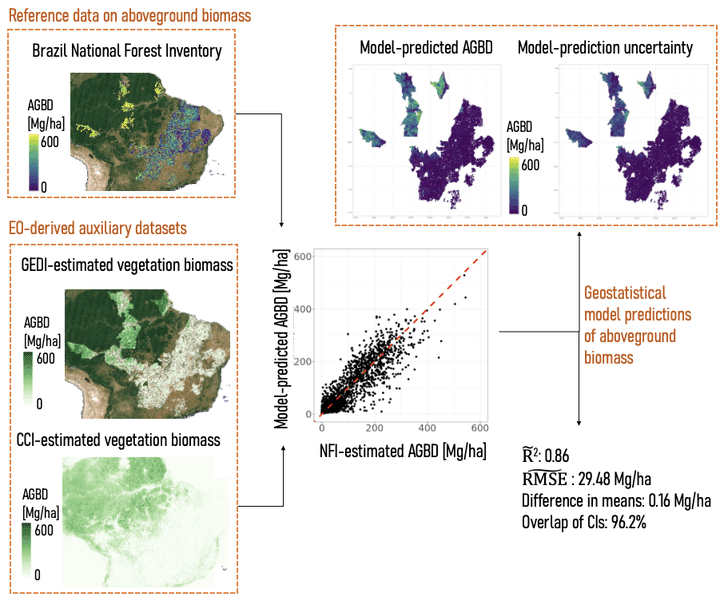
In the model-based approach, a geostatistical model-based approach is used to relate the Brazilian NFI to the auxiliary CCI and GEDI AGBD maps, with inference conducted through Bayesian methods. The model accounts for spatial-autocorrelation in the field data, hence allowing wall-to-wall predictions of biomass as well as area-wide summaries of mean biomass and standard errors.
Figure 1: Schematic summary of the geostatistical model-based approach
Click on the image to open it in full size
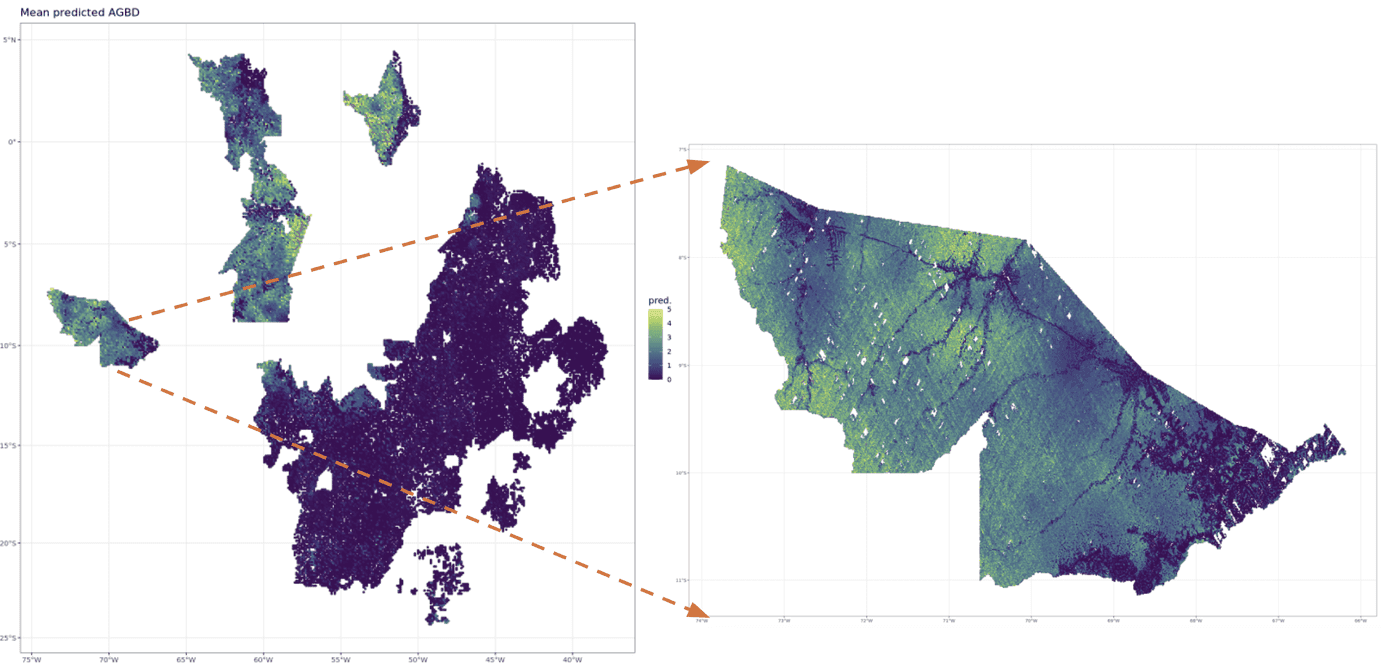
Figure 2: Posterior predictions of AGBD across the domain
Click on the image to open it in full size
The geostatistical model revealed a strong relation between the covariates and the observations (i.e., mean NFI-estimated AGBD for the plot cluster) across the domain. The model explained approximately 86% of the variability in the NFI-estimates of AGBD. Corresponding model errors were small and there is no strong evidence of systematic deviations in model predictions, with difference in means less than 1 Mg/ha of biomass. An appropriate coverage rate of the 95% credible intervals was noted.